Parts of a tree
The source guide identifies three main functional parts: roots, the woody structure above ground, and leaves.
Roots anchor the tree, absorb water and nutrients, and store carbohydrates. The trunk, branches, and stems lift the crown into the light and connect the roots to the leaves. Leaves act as the food-producing surface by capturing sunlight for photosynthesis.
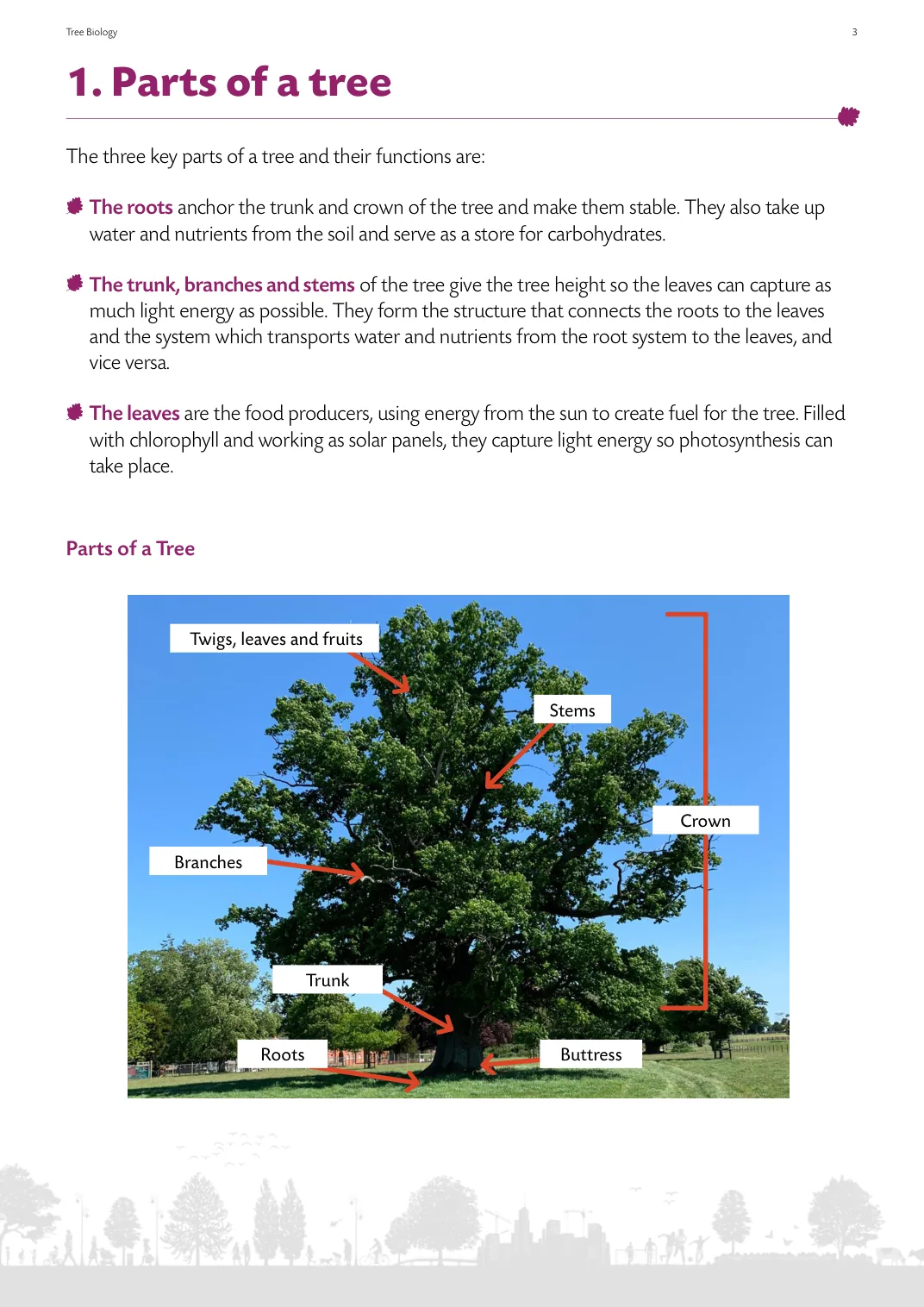
The three core parts
Roots
Hold the tree steady, draw in water and nutrients from the soil, and store reserves.
Trunk, branches, and stems
Provide height, support the crown, and carry water and nutrients between roots and leaves.
Leaves
Capture light energy and make food for the tree using chlorophyll.
Useful labels in the diagram
The illustrated page also points out the crown, buttress, twigs, fruits, stems, branches, trunk, and roots. These labels are useful for inspection and reporting because they help you describe exactly where you see a problem or feature.
Key takeaway
A tree works as one connected system. Roots, woody structure, and leaves each have a distinct job, but none works in isolation.
Knowledge check
Which part of the tree acts as the main food producer?